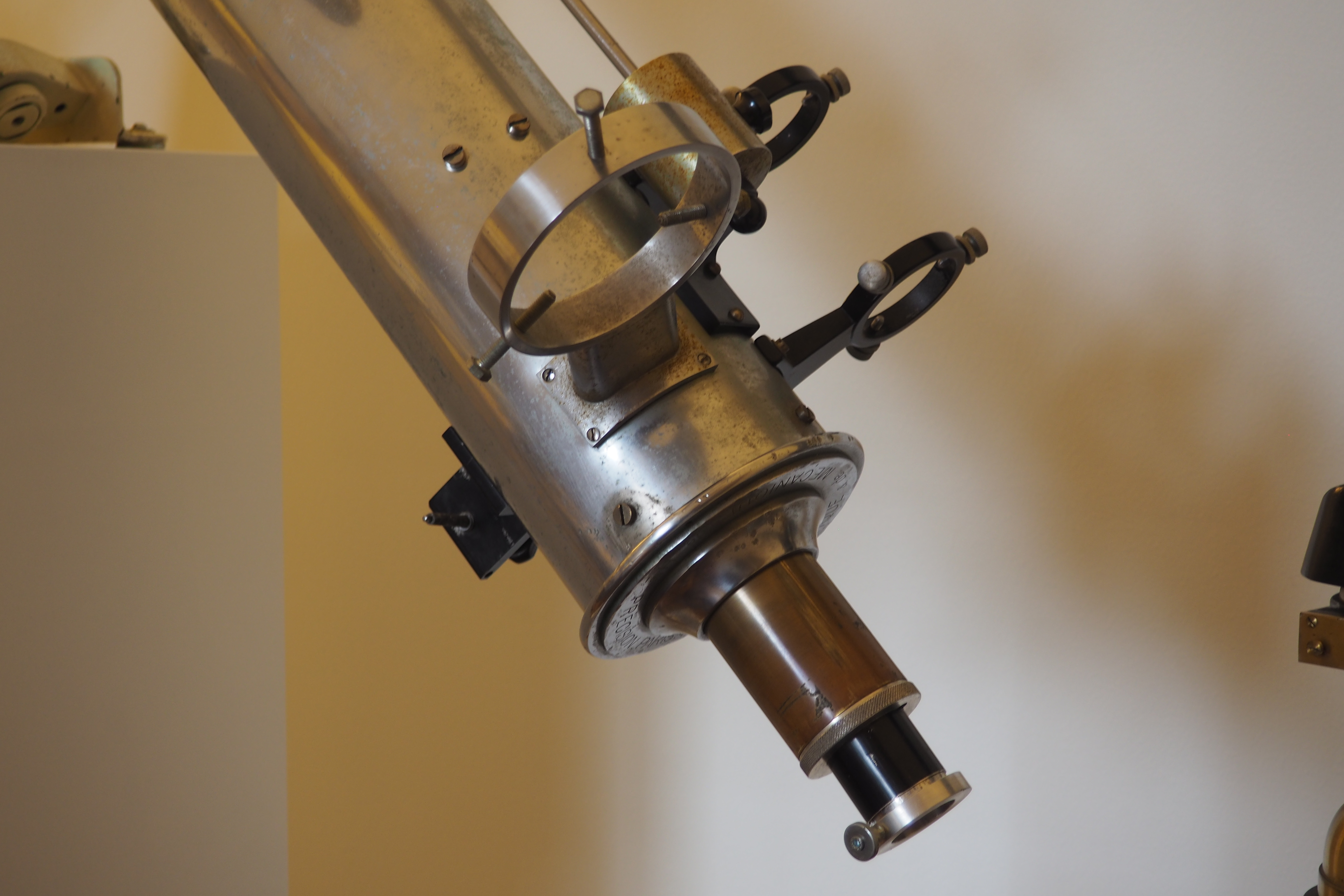
A refractor telescope on an alt-azimuth mount. Image: Wikimedia Commons (CC BY-SA 4.0)
The decision of which telescope to buy first depends less on budget than on intended use. A 70mm refractor and a 150mm Dobsonian reflector cost roughly the same, but deliver very different experiences. Understanding the three main optical designs — refractors, reflectors, and compound scopes — clarifies which trade-offs matter for your situation.
Refractors
A refractor uses a glass objective lens at the front of the tube to gather and focus light. The design is sealed, meaning the optical path is protected from air currents and dust, and there is no central obstruction (a secondary mirror) to reduce contrast. These properties make refractors well suited to lunar, planetary, and double-star observing.
The practical limit for a budget refractor is around 80–100mm of aperture. Beyond that, the cost rises steeply because large, high-quality glass is expensive to grind and figure. Most entry-level refractors in Canada fall in the 60–80mm range and retail between $150 and $400 CAD.
Typical Use
Moon, planets (Jupiter, Saturn, Mars), bright double stars, and widefield views of star clusters such as the Pleiades and the Beehive Cluster (M44).
Achromatic vs. apochromatic
Cheaper refractors use two-element achromatic objectives, which produce some false colour (usually a purple fringe around bright objects). Apochromatic designs use three or more lens elements to correct this, but the price increases substantially — often $700 CAD or more for an 80mm apochromat. For a first instrument, an achromatic 70–80mm is a workable starting point.
Reflectors
Reflectors use a curved primary mirror to focus light. The most accessible design for beginners is the Newtonian reflector mounted on a simple Dobsonian rocker box. A 150mm or 200mm Dobsonian delivers considerably more light-gathering than any budget refractor, and the price per millimetre of aperture is lower than any other telescope type.

A large Dobsonian reflector at a public star party. Image: Wikimedia Commons (CC BY-SA 2.0)
The trade-off is maintenance: mirrors require occasional cleaning and collimation (realignment of the optical path). Collimation takes about five minutes once you understand the process, and many observers find it straightforward after the first few attempts. A 150mm Dobsonian typically retails for $250–$450 CAD in Canada, and a 200mm version for $400–$600 CAD.
Typical Use
Deep-sky objects (nebulae, galaxies, globular clusters), planetary observing at modest magnification, and wide-field sweeping of the Milky Way.
Compound (Catadioptric) Scopes
Compound telescopes — primarily Schmidt-Cassegrains (SCTs) and Maksutov-Cassegrains (Maks) — fold a long focal length into a compact tube by bouncing light between mirrors. A Celestron 8-inch SCT has an 8-inch (203mm) mirror and a focal length of 2,032mm, yet the tube is only about 45cm long.
This portability advantage comes at a cost. Entry-level compound scopes, particularly those with motorized GoTo mounts, typically start at $800–$1,200 CAD. The optical design also introduces a central obstruction that reduces planetary contrast compared to a refractor of equivalent aperture, though in practice the difference is minor for most observers.
Where compound scopes shine is versatility: they work for planetary, deep-sky, and terrestrial observing. GoTo mount versions can locate thousands of objects automatically, which appeals to observers who want guided access to the catalogue rather than learning their way around the sky manually.
Mounts
The mount matters as much as the optical tube. Two fundamental types exist:
- Alt-azimuth (AZ): Moves up-down and left-right. Simple to use and quick to set up. Does not compensate for the Earth's rotation, so objects drift out of view at higher magnifications. The Dobsonian rocker box is a specialized alt-azimuth design.
- Equatorial (EQ): One axis aligns with the Earth's rotational axis, allowing the telescope to track objects with a single slow motion. Required for astrophotography and for extended high-power planetary sessions. Takes longer to polar-align at the start of each session.
For visual observing, an alt-azimuth or Dobsonian mount is generally the better first choice. The time saved on setup encourages more frequent observing.
Eyepieces and Accessories
Most telescopes ship with one or two basic eyepieces. A Plossl-design 25mm eyepiece is a reasonable starting point for wide-field views; a 10mm provides higher magnification for the Moon and planets. A Barlow lens doubles the effective magnification of any eyepiece and is often a cost-effective addition.
A red-light flashlight is essential for reading charts without destroying dark adaptation. The eye takes roughly 20–30 minutes to fully dark-adapt, and even a brief exposure to white light resets the process.
Where to Buy in Canada
Several Canadian retailers carry astronomy equipment, including Astronomics and stores specialising in optical equipment in major cities. The Royal Astronomical Society of Canada (RASC) maintains a network of local centres across the country; many hold equipment loans programs and can offer advice specific to your region.